Table of Contents
ToggleFish-themed wall decor brings instant visual interest to any space, whether you’re landlocked in the suburbs or living steps from the shore. Unlike generic artwork, fish decor adds movement, personality, and a touch of whimsy that works in living rooms, bathrooms, kitchens, and outdoor patios. The right piece can anchor a coastal design scheme or provide an unexpected pop of character in a modern farmhouse or industrial loft. From sleek metal sculptures to rustic reclaimed wood assemblies, fish wall art comes in materials and styles that fit nearly any budget and skill level, including pieces you can build yourself in a single weekend.
Key Takeaways
- Fish wall decor works across any design style—from coastal and modern farmhouse to industrial and boho—by adding organic movement and personality that softens hard architectural lines.
- Metal fish sculptures offer durability indoors and outdoors, while wooden fish bring warmth; both materials require proper sealing in humid bathrooms and kitchens to prevent damage.
- Choose the right size by measuring your wall: a piece spanning two-thirds to three-quarters of furniture width (like a sofa) creates the strongest visual impact.
- Mount securely by using studs or toggle bolts for pieces over 10 pounds, and verify wall anchors aren’t exceeded in weight rating to ensure safety for households with children or pets.
- DIY fish wall decor projects from scrap wood, driftwood, or metal flashing are achievable weekend builds that add personality and save money compared to store-bought pieces.
Why Fish Wall Decor Works in Any Home Style
Fish motifs translate across design styles more easily than most themed decor. In a coastal or nautical space, they’re an obvious fit alongside rope accents, driftwood, and shiplap. But fish art also complements:
- Modern farmhouse: Galvanized metal fish or whitewashed wooden schools add texture without clutter
- Industrial: Raw steel or welded iron fish sculptures play well against exposed brick and concrete
- Mid-century modern: Streamlined fish shapes in brass or copper echo the era’s love of organic forms
- Eclectic and boho spaces: Hand-painted ceramic fish or layered mixed-media pieces bring color and craft
The natural curves and scales of fish provide organic geometry that softens hard architectural lines. Unlike rigid geometric art, fish shapes introduce flow and direction, guiding the eye across a wall or around a corner.
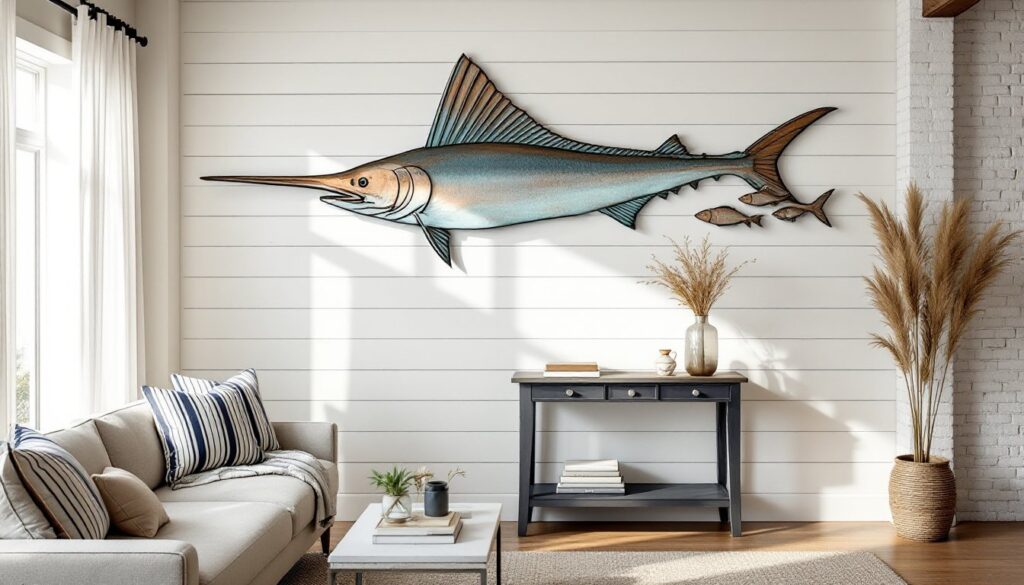
Size matters here. A single oversized marlin or sailfish (36–60 inches long) can serve as a focal point above a sofa or fireplace, while a school of smaller fish (8–12 inches each) creates rhythm and movement on an empty hallway wall. Many homeowners mix materials, pairing a metal fish with wooden paddles or vintage fishing gear, to build a curated, collected-over-time look.
Popular Types of Fish Wall Decor for Every Room
Metal Fish Art and Sculptures
Metal fish dominate the market for good reason: they’re durable indoors and out, and metal takes paint, patina, or powder coating well. Common materials include:
- Galvanized steel: Rust-resistant and affordable, ideal for humid bathrooms or covered patios
- Wrought iron: Heavy-gauge pieces with hand-forged details: expect to anchor into studs with appropriate wall anchors
- Copper and brass: Develop a natural patina over time: popular in kitchens and dining areas
- Recycled metal: Upcycled barn tin, old saws, or repurposed car parts add texture and backstory
Metal fish typically mount with keyhole slots or D-rings on the back. For pieces over 10 pounds, use toggle bolts rated for the weight if you’re not hitting a stud. Check the manufacturer’s hanging hardware, many budget imports include flimsy wire that should be upgraded before installation.
Outdoor metal fish will weather unless powder-coated or sealed. If you want the aged patina look, go for bare steel or copper. If you want color retention, look for UV-resistant powder coating or marine-grade paint.
Wooden Fish Decor and Reclaimed Materials
Wooden fish bring warmth and a handmade feel. Options range from carved solid wood to assembled plank designs. Key considerations:
- Solid carved wood: Typically pine, cedar, or mahogany: heavier and pricier but one-of-a-kind
- Plank-style fish: Cut from 1×6 or 1×8 boards (actual dimensions 3/4″ x 5.5″ or 7.25″), layered or edge-joined, then cut into a fish profile with a jigsaw or bandsaw
- Reclaimed pallet wood or barn siding: Adds character but may need sanding and sealing: check for nails, splinters, and rot before working with salvaged material
Wooden fish can be left natural, stained, or painted. If displaying in a bathroom or near a kitchen sink, seal with polyurethane or spar varnish to protect against moisture. Unsealed wood in humid environments will warp or develop mildew.
Weight varies: a 24-inch plank fish might weigh 3–5 pounds, while a solid carved piece of the same size can hit 8–10 pounds. Use picture hanging wire rated 20–30 pounds and mount to studs or use appropriately rated drywall anchors. For lighter pieces under 5 pounds, adhesive Command strips work but aren’t ideal for high-traffic or high-humidity areas.
How to Choose the Right Fish Wall Decor for Your Space
Start by measuring the wall space. A common mistake is going too small, fish decor reads best when it’s proportional to the furniture or architectural feature it’s anchoring. For a wall above a queen bed or a standard sofa (roughly 60–84 inches wide), aim for a piece or grouping that spans two-thirds to three-quarters of that width.
Consider the room’s existing palette. Metal fish in gunmetal, bronze, or verdigris (aged copper green) work well in rooms with gray, navy, or earth tones. Brightly painted wooden fish suit spaces with white walls and pops of coral, turquoise, or sunny yellow.
Humidity and location matter:
- Bathrooms: Stick with sealed wood, powder-coated metal, or resin. Avoid untreated natural materials.
- Kitchens: Grease and steam mean you’ll need washable surfaces, sealed wood or metal, not fabric or paper-based art.
- Outdoor covered patios: Go for weather-resistant metal or marine-grade sealed wood. Full sun will fade most paint over 2–3 seasons.
- Entryways and living rooms: Any material works: prioritize visual impact and secure mounting.
If you’re working with a rental or don’t want to patch drywall later, look for freestanding fish sculptures that lean against the wall or hang from picture rails and gallery systems.
Don’t overlook scale and species. A realistic tarpon or bass reads traditional and outdoorsy: a stylized koi or angelfish leans modern and artistic. A school of identical silhouettes feels contemporary, while a single sculptural statement piece anchors a maximalist or eclectic room.
Creative Placement Ideas That Make a Statement
Above the mantel or console table: This is classic for a reason. A horizontally oriented fish (marlin, sailfish, trout) mimics the shelf line and draws attention without competing with other decor. Leave 6–8 inches between the top of the furniture and the bottom of the art.
Stairwell or vaulted wall: Use the vertical or angled space by arranging a school of fish in an ascending pattern that follows the stair line. Vary sizes slightly to create depth, largest at eye level, smaller as they “swim” up or down.
Outdoor shower or poolside wall: Mount a single bold metal fish on a privacy fence, pergola post, or exterior shower wall. Ensure it’s anchored into the framing, not just siding or lattice, especially in windy areas.
Gallery wall integration: Mix fish decor with framed prints, small mirrors, or other three-dimensional objects. Keep a consistent color story (all metallics, all weathered wood, or all painted in a single palette) to avoid visual chaos. Space pieces 2–4 inches apart for a cohesive look.
Kitchen backsplash or open shelving backdrop: Small metal or ceramic fish (under 12 inches) can nestle between open shelves or hang on a tile backsplash using adhesive hooks rated for tile surfaces. This works best in kitchens with a coastal or eclectic vibe.
Projects involving furniture makeovers or painted accent walls pair well with new wall decor, fresh paint makes any art pop. If you’re repainting, choose a shade that contrasts with your fish decor: dark fish on light walls, or metallic fish on deep navy or charcoal.
DIY Fish Wall Decor Projects You Can Make This Weekend
Building your own fish wall art is approachable, even for beginners. Here are three proven projects:
Plank Fish from Scrap Wood
Materials: Scrap 1×6 or 1×8 pine boards (actual 3/4″ thick), wood glue, finishing nails or brad nails, jigsaw, sandpaper (80- and 120-grit), paint or stain, picture hanging wire.
- Draw or print a fish template (search “fish silhouette” online and scale to desired size).
- Arrange boards edge-to-edge and glue/clamp. Let dry 2–4 hours.
- Transfer template to the glued panel and cut out with a jigsaw. Sand all edges smooth.
- Paint, stain, or distress. Seal with polyurethane if using in a bathroom.
- Attach D-rings or picture wire to the back, centered about one-third down from the top.
Driftwood and Wire Fish Sculpture
Materials: Assorted driftwood pieces (or weathered fence pickets), 16- or 18-gauge galvanized wire, wood screws, drill with small bit, wire cutters, pliers.
- Lay out driftwood in a rough fish shape on a flat surface.
- Drill small pilot holes and connect pieces with screws or wire loops.
- Wrap wire around joints for a sculptural, sketchy look. Twist tightly with pliers.
- Add a wire loop or eye screw at the balance point for hanging.
This style suits rustic or coastal spaces and pairs well with creative home decor projects that emphasize texture over polish.
Stenciled Metal Fish from Flashing
Materials: Aluminum or copper flashing (sold in rolls at home centers, about $15–$25 for 10–20 feet), tin snips or aviation shears, fish stencil, permanent marker, metal file, spray paint (optional), leather gloves, safety glasses.
- Trace fish shape onto flashing with a marker. Wear gloves, metal edges are sharp.
- Cut out with tin snips. File all edges smooth to avoid cuts.
- Add texture by hammering gently on scrap wood or scoring scales with a nail.
- Spray paint if desired (use metal primer first for best adhesion).
- Punch a small hole near the top for hanging wire.
Metal projects generate sharp edges and small shards, always wear safety glasses and gloves. Work on a stable surface and dispose of scraps carefully.
For more detailed DIY decor tutorials, including finishing techniques and design variations, reference online craft communities that specialize in metalwork and woodworking.
Safety and Code Notes
All wall-mounted decor should be securely fastened, especially in homes with children or pets. If a piece weighs over 10 pounds, mount to a stud or use toggle bolts rated for the load. Wall anchors have weight ratings printed on the package, don’t exceed them. For exterior installations, check local building codes if you’re attaching to structural elements like pergola beams or fence posts: some jurisdictions have restrictions on modifications to shared fences or structures near property lines.
No electrical, plumbing, or structural permits are required for decorative wall art. But if you’re cutting into drywall to create recessed niches or mounting heavy sculptures to masonry, consult a professional to avoid damaging hidden wiring, pipes, or load-bearing elements.